
“Why am I having white discharge? Is it normal?” This is a common question many women search online but may hesitate to discuss openly. Vaginal discharge, commonly called white discharge or safed paani, is often a normal part of female reproductive health. The vagina naturally produces fluid and mucus to maintain moisture and help remove cells and other material.
However, changes in the color, texture, smell, amount, or accompanying symptoms can sometimes indicate an infection or another health condition. Understanding the white discharge reasons can help you recognize what is likely normal and when medical evaluation may be appropriate.
In this guide, we will explain why white discharge happens, what normal vaginal discharge looks like, how it changes during the menstrual cycle, common causes of abnormal discharge, warning signs, and when you should consult a healthcare professional.
What Is Normal White Discharge?
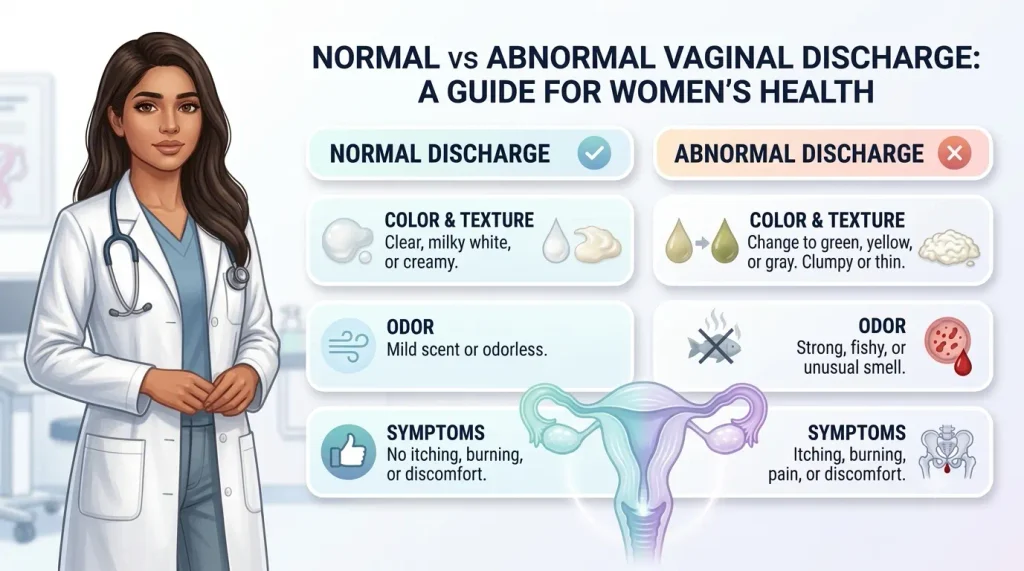
Vaginal discharge is usually a natural body process. Understanding the white discharge reasons can help you recognize why discharge occurs and whether it is part of normal vaginal health. A healthy vagina produces fluids and mucus that help keep the vaginal environment moist, support its normal function, and remove old cells. The amount and consistency of discharge can naturally change due to hormonal fluctuations, ovulation, pregnancy, and other normal reproductive changes. The discharge may contain:
- Cervical mucus
- Cells from the vaginal walls and cervix
- Naturally occurring vaginal bacteria
- Fluid produced by vaginal tissues
Normal discharge can help maintain vaginal moisture and remove old cells.
How to Recognize Normal Discharge
| Feature | Normal Discharge |
|---|---|
| Color | Clear, milky white, or off-white |
| Texture | Thin, watery, creamy, or slightly sticky |
| Smell | Mild or barely noticeable |
| Itching | Usually absent |
| Burning | Usually absent |
| Pain | Usually absent |
| Amount | Can vary from person to person |
The amount and consistency of discharge can naturally change throughout the menstrual cycle, which is one of the common White Discharge Reasons. Hormonal changes around ovulation and before a period may make discharge more noticeable on certain days. Therefore, having more discharge on some days does not automatically mean that you have an infection, especially when there is no unusual odor, itching, burning, pain, or abnormal color.
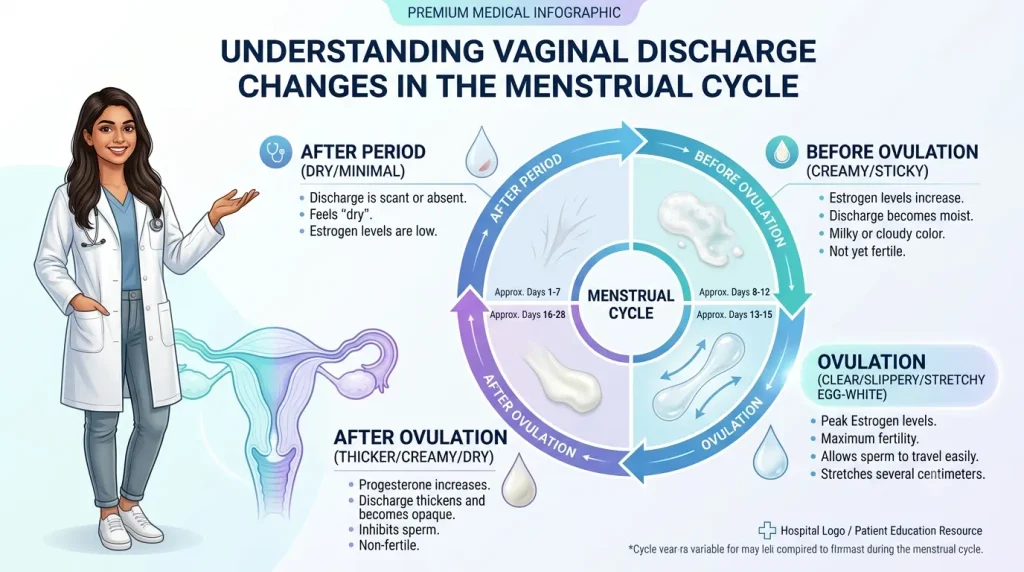
How Does Discharge Change During the Menstrual Cycle?
Hormonal changes can affect the amount and consistency of vaginal and cervical discharge. Estrogen and progesterone are two hormones that play an important role in these changes.
After Your Period
Immediately after menstruation, some women notice very little discharge. A small amount of brown discharge toward the end of a period may simply represent older blood and is not necessarily a sign of a health problem. These normal menstrual changes can also be part of understanding White Discharge Reasons, as vaginal discharge naturally varies throughout the cycle.
Before Ovulation
As ovulation approaches, estrogen levels rise and cervical mucus may gradually become wetter, clearer, creamier, or more slippery.
Around Ovulation
Around ovulation, cervical mucus may become clear, slippery, and stretchy, sometimes resembling raw egg white. This type of cervical mucus is commonly associated with the fertile window and may help sperm move through the reproductive tract.
After Ovulation
After ovulation, progesterone becomes more prominent. Discharge may become thicker, creamier, or cloudier and may decrease as the next period approaches. These hormonal changes are among the common White Discharge Reasons and are generally considered normal when they are not accompanied by unusual odor, itching, burning, or pain.
These normal hormonal changes are an important part of understanding white discharge reasons.
White Discharge Reasons: Why Does White Discharge Happen?
Not every case of white discharge is caused by an infection. Several normal physiological and hormonal factors can increase or change vaginal discharge.
1. Hormonal Changes
Hormonal fluctuations during the menstrual cycle can affect vaginal and cervical mucus. These hormonal changes are also among the common White Discharge Reasons, as they can influence the amount, color, and consistency of discharge at different stages of the cycle. Some women notice increased discharge around ovulation, before their period, or during other hormonal changes.
2. Ovulation
Ovulation is one of the common white discharge reasons when the discharge becomes more noticeable. Around ovulation, cervical mucus may become clearer, wetter, and more stretchy. This is one of the common White Discharge Reasons linked to normal hormonal changes during the menstrual cycle. If there is no unusual odor, itching, burning, or pain, this type of discharge can be a normal part of the fertile window.
3. Sexual Arousal
Sexual arousal naturally increases vaginal lubrication. This temporary increase in vaginal fluid may appear as additional discharge or wetness and is one of the normal White Discharge Reasons. It does not usually indicate an infection when there is no unusual odor, itching, burning, pain, or other concerning symptoms.
This is a normal physiological response and does not necessarily indicate an infection.
4. Pregnancy
Pregnancy can increase vaginal discharge because of hormonal changes and increased blood flow to the reproductive tissues. This pregnancy-related discharge is commonly called leukorrhea. It is generally thin or milky white and may have a mild odor.
However, unusual color, strong odor, itching, pain, or bleeding during pregnancy should be discussed with a healthcare professional. These changes may indicate a condition that requires evaluation and should not be assumed to be normal White Discharge Reasons during pregnancy.
5. Hormonal Birth Control
Birth control pills and other hormonal contraceptive methods can affect cervical mucus and vaginal discharge.
Some women may notice more discharge, while others may notice less. Changes caused by hormonal birth control can be among the White Discharge Reasons, as contraceptive hormones may affect cervical mucus and vaginal fluid. If a new or unusual discharge develops along with irritation, pain, or a strong odor, medical advice may be appropriate.
6. Puberty
During puberty, reproductive hormones become more active. Vaginal discharge may begin before the first menstrual period. The timing varies from person to person, but developing vaginal discharge can be a normal part of reproductive maturation.
7. Perimenopause and Menopause
Hormonal changes during perimenopause and menopause can alter vaginal tissues and discharge. These hormonal shifts can be among the White Discharge Reasons, although some women may experience less discharge and increased vaginal dryness as estrogen levels decline. Any new, persistent, foul-smelling, or blood-stained discharge after menopause should be evaluated by a healthcare professional.
Some women experience less discharge and increased vaginal dryness as estrogen levels decline. New, persistent, foul-smelling, or blood-stained discharge after menopause should be evaluated by a healthcare professional.
When Is White Discharge Abnormal?
Discharge may be considered unusual when there is a significant change from your normal pattern, particularly when the change occurs along with other symptoms.
Color alone cannot diagnose an infection. Understanding the White Discharge Reasons requires considering the discharge’s smell, texture, associated symptoms, and your medical history. These factors can help a healthcare professional determine whether the changes are likely to be normal or may require further evaluation.
Changes in Discharge Color
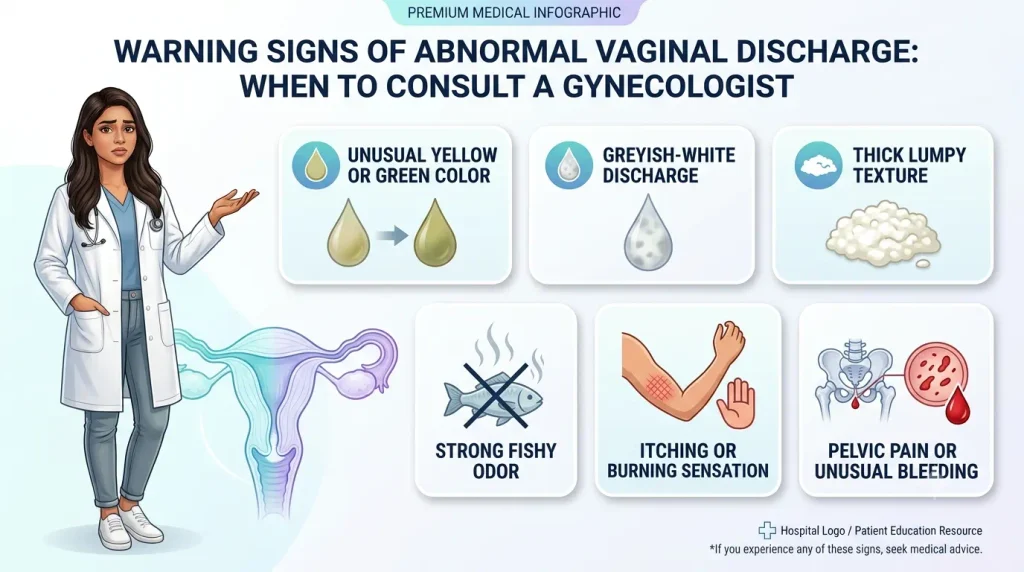
- Yellow or green discharge: May occur with certain infections, including some sexually transmitted infections.
- Greyish-white discharge: Can occur with bacterial vaginosis (BV).
- Pink or blood-stained discharge: Bleeding outside your expected period may require medical evaluation.
- Brown discharge: May represent older blood, but persistent or unexplained bleeding should be assessed.
Changes in Texture
- Very thick, white, lumpy discharge may occur with a vaginal yeast infection.
- Foamy discharge may occur with certain infections, including trichomoniasis.
- Unusually watery discharge should be considered along with other symptoms and circumstances.
Changes in Smell
A mild natural vaginal odor can be normal and does not necessarily indicate a health problem. Understanding the White Discharge Reasons is important because changes in odor, especially when combined with changes in discharge texture or other symptoms, may provide useful clues about the underlying cause. However:
- A strong fishy odor can occur with bacterial vaginosis.
- A strong unpleasant or foul odor may occur with an infection or another condition.
- Yeast infections typically do not cause a strong fishy odor, although symptoms can vary between individuals.
Other Symptoms to Watch For
Unusual discharge deserves more attention when accompanied by:
- Intense vaginal itching
- Burning
- Redness or swelling
- Painful urination
- Pelvic or lower abdominal pain
- Pain during sex
- Bleeding between periods
- Bleeding after sex
- Fever
Common Causes of Abnormal White Discharge
1. Vaginal Yeast Infection
A vaginal yeast infection, also known as vaginal candidiasis, occurs when Candida yeast grows excessively in the vagina. It is one of the possible White Discharge Reasons when the discharge becomes thick, white, and lumpy, particularly when accompanied by intense itching, burning, redness, or swelling. However, these symptoms can overlap with other vaginal conditions, so proper medical evaluation may be needed when the diagnosis is uncertain or symptoms keep returning.
Common symptoms may include:
- Thick, white, lumpy discharge
- Intense vaginal itching
- Burning
- Redness
- Swelling
- Discomfort during sex or urination
Factors such as recent antibiotic use, pregnancy, diabetes, and certain immune-related conditions may increase the risk.
Not every thick white discharge is caused by yeast. If symptoms are recurrent or the diagnosis is uncertain, medical evaluation is recommended.
2. Bacterial Vaginosis
Bacterial vaginosis (BV) occurs when the normal balance of vaginal bacteria changes. Possible symptoms include:
- Thin white or grey discharge
- Fishy vaginal odor
- Odor that may become more noticeable after sex
- Mild irritation in some cases
Bacterial vaginosis (BV) occurs when the normal balance of vaginal bacteria changes. It is one of the possible White Discharge Reasons when discharge becomes thin, white, or grey and may be accompanied by a fishy odor. BV is not classified as a traditional sexually transmitted infection, although sexual activity can influence the risk of developing it. If symptoms are persistent, unusual, or recurrent, a healthcare professional can help determine the appropriate diagnosis and treatment.
Douching can disturb the vaginal bacterial environment and may increase the risk of BV.
3. Trichomoniasis
Trichomoniasis is a sexually transmitted infection caused by the parasite Trichomonas vaginalis. It is one of the possible infectious White Discharge Reasons, particularly when discharge becomes unusual in color, frothy, or associated with an unpleasant odor, itching, burning, or irritation. Because some people may have mild or no symptoms, appropriate testing is important when there is a potential exposure or persistent unusual discharge.
Possible symptoms include:
- Yellow-green or grey discharge
- Frothy discharge
- Unpleasant odor
- Itching
- Burning
- Pain during urination
- Genital irritation
Some people have mild symptoms or no symptoms at all. Trichomoniasis is treatable with prescribed medication. Sexual partners may also need evaluation and treatment to reduce the risk of reinfection.
4. Chlamydia and Gonorrhea
If there has been a potential STI exposure, appropriate testing is important because symptoms alone cannot reliably rule out an infection. Certain sexually transmitted infections can cause unusual vaginal discharge and may be among the possible White Discharge Reasons, while some infections may cause few or no noticeable symptoms. A healthcare professional can recommend the appropriate tests based on your symptoms and individual circumstances.
5. Cervicitis
Cervicitis means inflammation of the cervix. It may result from an infection, including certain sexually transmitted infections, or from other causes. Possible symptoms include:
- Unusual vaginal discharge
- Bleeding between periods
- Bleeding after sex
- Pelvic discomfort
- Pain during sex
Persistent symptoms may require a physical examination and appropriate testing.
White Discharge: Myths vs Facts
| Myth | Fact |
|---|---|
| “White discharge is always a disease.” | Normal vaginal discharge is a natural body process. |
| “Discharge means poor hygiene.” | Normal discharge is not a sign of poor cleanliness. |
| “A vaginal wash should be used to stop discharge.” | The vagina is self-cleaning, and unnecessary douching or scented products may cause irritation. |
| “More discharge always means infection.” | Ovulation, pregnancy, and hormonal changes can naturally increase discharge. |
| “Only unclean women get yeast infections.” | Yeast infections can affect women for several reasons and are not simply caused by poor hygiene. |
| “BV only affects sexually active women.” | BV can occur regardless of sexual activity. |
| “Healthy discharge should have absolutely no smell.” | A mild natural odor can be normal; a strong unpleasant odor may be concerning. |
| “All abnormal discharge is treated the same way.” | Treatment depends on the underlying cause, so accurate diagnosis is important. |
When Should You See a Doctor?
If your discharge becomes noticeably different from your usual pattern, especially when symptoms persist or worsen, consider consulting a gynecologist or qualified healthcare professional. Understanding the White Discharge Reasons can help identify whether the change may be related to normal hormonal variations, an infection, or another condition that requires medical evaluation.
Seek Medical Advice Promptly If:
- Discharge becomes yellow, green, or grey
- There is a strong fishy or unpleasant odor
- Discharge becomes unusually thick and lumpy
- You have severe itching or burning
- The vaginal area becomes red or swollen
- Urination causes pain or burning
- You develop pelvic or lower abdominal pain
- Sex becomes painful
- You experience bleeding between periods
- You experience bleeding after sex
- Fever occurs with unusual discharge
- Symptoms persist or become worse
- You may have been exposed to an STI
During pregnancy, unusual discharge accompanied by bleeding, pelvic pain, fever, strong odor, or other concerning symptoms should be discussed with a healthcare professional promptly.
White Discharge and Age: What Is the Connection?
During Puberty
Vaginal discharge can begin during puberty as reproductive hormones become active. This hormonal development is one of the normal White Discharge Reasons, as changing estrogen levels can influence vaginal and cervical mucus. Discharge may occur before the first period and can be a normal part of reproductive development.
During the Reproductive Years
During reproductive age, vaginal discharge commonly changes according to the menstrual cycle. Ovulation, pregnancy, hormonal contraception, and sexual arousal can all affect its amount and consistency.
During Pregnancy
Increased white or milky discharge is common during pregnancy and can be one of the normal White Discharge Reasons related to hormonal changes and increased blood flow to the reproductive tissues. However, strong odor, unusual color, itching, pain, or bleeding should not automatically be considered normal pregnancy discharge and should be discussed with a qualified healthcare professional.
After Menopause
Lower estrogen levels after menopause can contribute to vaginal dryness and changes in discharge. These hormonal changes can be among the White Discharge Reasons associated with menopause. While some changes may be normal, new, persistent, foul-smelling, or blood-stained discharge after menopause should be evaluated by a qualified healthcare professional.
However, new, persistent, foul-smelling, or blood-stained discharge after menopause should be evaluated by a healthcare professional. Understanding the possible White Discharge Reasons is particularly important after menopause because changes in vaginal discharge may sometimes be related to vaginal or cervical conditions that require medical assessment.
How to Manage Normal White Discharge
Normal discharge does not need to be stopped. Understanding the White Discharge Reasons can help you recognize that normal vaginal discharge is often a natural part of reproductive health. Instead, the goal should be to maintain gentle hygiene, protect the natural vaginal environment, and avoid unnecessary irritation.
What You Can Do
- Gently clean the external vulval area.
- Plain water is generally sufficient for external cleaning.
- Wear breathable underwear.
- Change damp or sweaty clothing promptly.
- Change menstrual products regularly.
- Practice safer sex.
- Consider STI testing when appropriate.
- Consult a healthcare professional for persistent or recurrent symptoms.
What to Avoid
- Avoid vaginal douching.
- Avoid scented vaginal sprays and unnecessary intimate products.
- Do not use antibiotics or antifungal medication without appropriate medical advice.
- Avoid relying on unverified home remedies.
- Do not ignore persistent changes in discharge, particularly when accompanied by pain, odor, itching, or bleeding.
Can Diet Affect White Discharge?
Diet is important for overall health, but there is no single food that can reliably stop normal vaginal discharge. Understanding the White Discharge Reasons is more important than relying on specific foods or home remedies, as normal discharge can be influenced by hormones, ovulation, pregnancy, and other natural changes. A balanced diet and adequate hydration can support overall well-being, but unusual discharge should be evaluated based on its symptoms and possible underlying cause.
A balanced diet, adequate hydration, and a healthy lifestyle support general well-being. However, if discharge is unusual, identifying and treating the underlying cause is more important than relying on food-based remedies.
Can White Discharge Be Treated at Home?
If discharge is normal and there is no itching, burning, pain, strong odor, or unusual color, treatment is generally not required. If symptoms suggest an infection, self-treatment may not be appropriate because different conditions can have similar symptoms but require different treatments. For recurrent, severe, or unusual symptoms, consult a qualified healthcare professional for an accurate diagnosis.
FAQs About White Discharge Reasons
Is having white discharge every day normal?
Daily vaginal discharge can be normal for many women. Its amount and consistency may vary throughout the menstrual cycle due to natural hormonal changes. These normal variations are among the common White Discharge Reasons, especially when the discharge is clear, milky white, or off-white and is not accompanied by unusual odor, itching, burning, or pain. If there is no strong odor, itching, burning, pain, or unusual color, the discharge may simply be part of normal vaginal function.
How can I stop white discharge permanently?
Normal vaginal discharge should not be permanently stopped because it is part of the vagina’s natural function.
If the discharge is unusual, the underlying cause should be identified first. Understanding the White Discharge Reasons can help determine whether the change is related to normal hormonal variations, an infection, or another condition. Avoid taking medication or using home remedies without knowing the cause, as different conditions may require different treatments.
At what age does white discharge start?
Vaginal discharge can begin during puberty as reproductive hormones become active. The exact age varies from person to person. Discharge before the first period can be a normal sign of reproductive maturation.
How many days before a period does white discharge occur?
There is no fixed number of days when white discharge must occur before a period. The timing and amount can vary from person to person and from one menstrual cycle to another, which is important when understanding White Discharge Reasons.
After ovulation, discharge may become thicker or creamier, and some women notice changes as their period approaches. These changes are often related to normal hormonal fluctuations. Every menstrual cycle can be different, so variations in discharge do not necessarily indicate a health problem.
Does yeast infection discharge have a smell?
Yeast infection discharge generally does not have a strong fishy odor. Understanding the White Discharge Reasons can help distinguish common patterns, although discharge characteristics alone cannot confirm a diagnosis. Thick, white, lumpy discharge accompanied by intense itching and irritation is more commonly associated with vaginal candidiasis.
A fishy odor is more commonly associated with bacterial vaginosis, although symptoms can overlap. If symptoms are persistent, severe, or unusual, consult a qualified healthcare professional for appropriate evaluation.
Can white discharge confirm pregnancy?
No. White discharge alone cannot confirm pregnancy. Pregnancy can increase vaginal discharge because of hormonal changes and increased blood flow to the reproductive tissues. This can be one of the normal White Discharge Reasons during pregnancy. However, white discharge alone cannot confirm pregnancy. A pregnancy test is needed to determine whether you are pregnant.
Can stress affect vaginal discharge?
Stress can affect hormones and the menstrual cycle, which may cause some women to notice changes in their discharge pattern. However, unusual discharge should not automatically be attributed to stress, particularly when itching, odor, pain, or other symptoms are present.
Is white discharge dangerous?
Normal white discharge is generally not dangerous and can be a natural part of vaginal health. Understanding the White Discharge Reasons can help distinguish normal hormonal changes from symptoms that may require attention.
However, unusual discharge accompanied by a strong odor, itching, burning, pelvic pain, unusual bleeding, fever, or other concerning symptoms may indicate an infection or another condition that requires medical evaluation. If these symptoms persist or worsen, consult a qualified healthcare professional.
Conclusion
Understanding white discharge reasons can help women distinguish between normal vaginal changes and symptoms that may need medical attention. Clear, milky white, or off-white discharge without strong odor, itching, burning, or pain is often part of normal vaginal health. Its amount and consistency can naturally change with the menstrual cycle, ovulation, pregnancy, and hormonal changes.
On the other hand, significant changes in color, texture, smell, or associated symptoms should not be ignored. Understanding the possible White Discharge Reasons can help you recognize when a change may be related to normal hormonal variations and when it may require medical evaluation. Persistent or concerning changes, especially when accompanied by itching, burning, pain, unusual bleeding, or fever, should be discussed with a qualified healthcare professional.
Key Takeaways
- White or clear vaginal discharge is often a normal body function.
- Discharge can naturally change throughout the menstrual cycle.
- Ovulation may cause clear, slippery, and stretchy cervical mucus.
- Thick, lumpy discharge with intense itching can occur with a yeast infection.
- Thin greyish-white discharge with a fishy odor can occur with bacterial vaginosis.
- Yellow-green, frothy, or foul-smelling discharge may indicate an infection.
- Pelvic pain, fever, unusual bleeding, or painful urination should be medically evaluated.
- Normal vaginal discharge does not need to be stopped.
- Avoid douching and unnecessary scented intimate products.
- Do not self-medicate without knowing the underlying cause.
- Persistent, recurrent, or unusual symptoms should be discussed with a qualified healthcare professional.
Your body can naturally produce vaginal discharge as part of maintaining a healthy vaginal environment. Understanding your usual pattern makes it easier to recognize meaningful changes and seek medical care when needed.
Medical Disclaimer:
This article about White Discharge Reasons is intended for general educational purposes only and should not be considered a substitute for professional medical advice, diagnosis, or treatment. Vaginal discharge can have different causes depending on your symptoms, medical history, and individual circumstances. If you experience persistent, severe, or unusual symptoms, consult a qualified gynecologist or healthcare professional for appropriate evaluation. Avoid self-diagnosis and self-medication.
Medical Review Recommendation:
Because this is health/YMYL content, consider having the article reviewed by a qualified gynecologist or healthcare professional before publication. Add the author’s name, medical reviewer’s credentials, and a visible “Last Reviewed/Updated” date to strengthen transparency and trust.